Thursday, September 19, 2013


Sunday, September 15, 2013
Grand Canyon Trust announces 2012 John Wesley Powell Award recipients
A great honor for Jayne to be one of the first two scientists to receive this award
Grand Canyon Trust announces 2012 John Wesley Powell Award recipients
Grand Canyon Trust announces 2012 John Wesley Powell Award recipients
Saturday, September 14, 2013
Thursday, September 12, 2013
Biocrusts of Northern Arizona National Monuments Post 3: Walnut Canyon
This is my third post on the theme of biocrusts in the National Monuments of Northern Arizona. Find a lichen key here, and a moss key here. Walnut Canyon, Wupatki, Sunset Crater, Montezuma Castle (& Well), and Tuzigoot were sampled.
Walnut Canyon- Of the National Monuments sampled above the Mogollon rim, Walnut Canyon is where BSCs are most consistently important.
We
sampled intermediate precipitation portions of the Walnut Canyon
rim that had been fenced since at least 1974. We also used surrogate sites with
Kaibab limestone parent materials in range exclosures near Flagstaff,
and on the south rim of the Grand Canyon to
capture more variance in climate parameters. In general, we found that the
entire canyon rim likely has potential for BSC cover . Even in sites
known to have burned relatively recently, we were able to find some BSC
development.
We made the simplifying assumption that the canyon bottom
was unavailable to BSCs due to flooding, and that the canyon walls were too
steep to afford more than minimal available habitat. North facing slopes
supporting Douglas fir stands were examined and found to contain very little
BSC habitat. We did observe the mosses S.
ruralis and Brachythecium sp.,
growing along with the lichen Cladonia
fimbriata primarily growing in rock crevices and on organic matter. Because
of the steep rocky terrain, very low available BSC habitat, and the low spatial
extent of these habitats, we chose not to formally survey them.
 |
| The entire Walnut Canyon Rim has potential to support BSCs, regardless of the vegetation type. a) A cyanobacterial-lichen BSC amidst ponderosa pine litter in a ponderosa pine habitat (inset). b) A cyanobacterial-lichen BSC between Bouteloua gracilis, and surface rocks in an open grassy pinyon-juniper savannah (inset) |
Sunday, September 1, 2013
Biocrusts of Northern Arizona National Monuments, Post 2: Moss key
This is my second post on biocrusts of National Monuments of Northern Arizona. See yesterdays post for a lichen key, here's a moss key. Liverworts were not observed by surveyors, but they are likely out there. The keys apply to Wupatki, Walnut Canyon, Sunset Crater, Montezuma Castle (& Well), and Tuzigoot National Monuments.
Field-based key to common biocrust mosses of National Monuments of the southern Colorado Plateau and Colorado Plateau-Sonoran Desert ecotone
5bb) Seta a few mm long, sporophyte capsule exerted, calyptra splits along a single seam, plants very small and awns are much more more visible...............................Pterygoneurum ovatum
Field-based key to common biocrust mosses of National Monuments of the southern Colorado Plateau and Colorado Plateau-Sonoran Desert ecotone
1a) Upper leaves or entire plant white or silvery due to lack of chlorophyll; plants usually small (0.5 mm tall)................Bryum argenteum complex (may include B. argenteum, B. lanatum)
1b) Plants not whitish or silvery; plant sizes various............. 2
2a) Plants light green to yellowish, stems up to several cm long, frequently branched with a creeping growth form ……Brachythecium spp.
2b) Plants various colors, stems usually less than 1 cm, not branched or only sparingly branched and.….3
3a) Plants lacks awns (hair points on leaf tips), light green to black...4
4a) Plant light green, large (>1mm common) tongue shaped leaves (may be contorted when dry) with mucro at apex, Almost always bearing straight, erect sporophytes (~1-2.5 cm tall); older sporophytes exhibit cylindrical capsules topped with a characteristic white column ....................................Tortula inermis
4b) Plant forest green above and reddish brown below when dry, shorter plants with linear-lanceolate leaves (sometimes contorted, sometimes ~ imbricate); if present mature sporophytes red with inclined capsule .............................................Ceratodon purpureus
3b) Plants with awns (usually whitish and toothed); colors various..5
5a) White awns longer than plant height; often giving appearance of white fuzzy tuft because plant is buried or inconspicuous ............Pterygoneurum spp. (Almost always P. ovatum but can’t be keyed in field without sporophyte)**
5b)White or yellowish awn length less than plant height; plants are generally above ground and easy to see .....6
6a) Awn is a yellowish extension of an acuminate leaf tip, wider at base; plant yellowish green or golden, mostly < 1mm tall .......................7
7a) Plant yellowish green, rarely in dense cushions; arid regions....Bryum kunzei
7b) Plant golden yellow with a magenta colored stem (view wet), frequently in dense cushions; prefers shrub canopies in higher elevation areas.....Bryum caespiticium
7b) Plant golden yellow with a magenta colored stem (view wet), frequently in dense cushions; prefers shrub canopies in higher elevation areas.....Bryum caespiticium
6b) Awn is white and ~ same width along its entire length, plants light green, or darker (not yellow).....8
8a) Plants tall, often > 3mm height; plants lime green-dark green at top, reddish at base; leaves slightly twisted around stem when dry squarrose-recurved (curling back > 90º back from stem) when wet, costa frequently red …………...Syntrichia ruralis
8b) Plants small-med, usually less than 3mm tall: plants dark green-blackish at top, brown at base; leaves not twisted around stem when dry, patent (not curling back > 90º), costa never red…....Syntrichia caninervis
** If sporophyte is present:
5aa) Due to a short seta, the sporophyte capsule is immersed in leaves or barely sticking out, calyptra splits in 2 or more places, plants about 1mm high and green......Pterygoneurum subsessile5bb) Seta a few mm long, sporophyte capsule exerted, calyptra splits along a single seam, plants very small and awns are much more more visible...............................Pterygoneurum ovatum
Saturday, August 31, 2013
Biocrusts of Northern Arizona National Monuments, Post 1
Preface: I was looking through some old files the other day, and ran across a report I had written on an old research project. The goal of the research was to model the potential abundance of biocrusts in Wupatki, Sunset Crater, Walnut Canyon, Montezuma's Castle (and Well), and Tuzigoot National Monuments in Northern Arizona. The first three are near Flagstaff on the Southern Colorado Plateau. The others are in the Verde River watershed which has more Sonoran Desert vegetation elements.
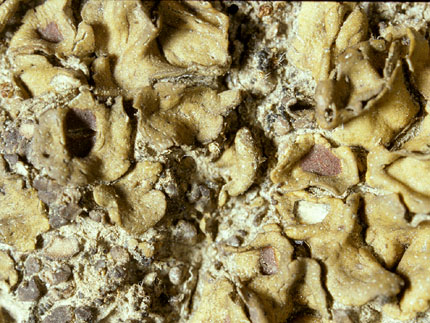
I never published this, because frankly, the models just were not very exciting. I completely forgot that as peripheral matter, I created species lists, keys, and verbal descriptions and photos of the biocrusts in these National Monuments. It seems a shame for them to just be in a report which only a few people have, so I have decided to share them here in a series of posts. Here's a key to biocrust lichens in the area. (Please note that the Sedona area was not part of sampling and that many more biocrust species would be found there).
1a) Thallus crustose, subfoliose, foliose, fruticose or gelatinous...................2
2a) Thallus erect-fruticose, tan to olive green, with white dots (pseudocyphellae) ……………………………………………………………………….Aspicilia hispida
3a) Thallus foliose, large (usually > 5cm dia.), gray to grayish brown or brown, with felt-like texture on upper surface, commonly with large red apothecia at margins ………………………………………………....Peltigera rufesence
4a) Thallus some shade of yellow or orange ..................................5
5a) Thallus crustose with distinctly lobate margins; lemon yellow usually with some white showing underneath (rarely all white); often with 1mm dia. rust colored apothecia ………....................................Fulgensia desertorum
5b) Thallus inconspicuous, but densely covered with orange apothecia ………….Caloplaca jungermanii
4b) Thallus colored otherwise ........................................................6
6a) Thallus crustose, white to beige, usually with dark gray to black apothecia ………….……Diploschistes muscorum
1b) Thallus squamulose ....................................................................................................8
8a) Thallus consisting of gray-green basal squamules, and sometimes erect columns (podetia), found at middle to upper elevations ………………….….....9
9a) Podetia narrow and trumpet shaped …………...….Cladonia fimbriata
9b) Podetia lack cup at top, finger shaped, may have brown apothecia near top of podetia ……. ………………………………….….Cladonia cariosa
8b) Squamules not gray-green, podetia always lacking, various
11b) Squamules mostly > 1mm, cream to light brown to almost black;
15a) Squamules solitary or sparsely scattered with an irregular
10b) Squamules not brown; Apothecia may be present...............................16
16a) Squamules pink to brick red with a white margin; apothecia
I never published this, because frankly, the models just were not very exciting. I completely forgot that as peripheral matter, I created species lists, keys, and verbal descriptions and photos of the biocrusts in these National Monuments. It seems a shame for them to just be in a report which only a few people have, so I have decided to share them here in a series of posts. Here's a key to biocrust lichens in the area. (Please note that the Sedona area was not part of sampling and that many more biocrust species would be found there).
Field-based key to common Biocrust lichens of National Monuments in the southern Colorado
Plateau and Colorado
Plateau-Sonoran Desert
ecotone
1a) Thallus crustose, subfoliose, foliose, fruticose or gelatinous...................2
2a) Thallus erect-fruticose, tan to olive green, with white dots (pseudocyphellae) ……………………………………………………………………….Aspicilia hispida
2b) Thallus crustose, subfoliose, foliose or gelatinous, various colors
………..…….3
3a) Thallus foliose, large (usually > 5cm dia.), gray to grayish brown or brown, with felt-like texture on upper surface, commonly with large red apothecia at margins ………………………………………………....Peltigera rufesence
3b) Thallus crustose
or gelatinous ………………………………………..….…4
4a) Thallus some shade of yellow or orange ..................................5
5a) Thallus crustose with distinctly lobate margins; lemon yellow usually with some white showing underneath (rarely all white); often with 1mm dia. rust colored apothecia ………....................................Fulgensia desertorum
5b) Thallus inconspicuous, but densely covered with orange apothecia ………….Caloplaca jungermanii
4b) Thallus colored otherwise ........................................................6
6a) Thallus crustose, white to beige, usually with dark gray to black apothecia ………….……Diploschistes muscorum
6b) Thallus gelatinous; usually black but occasionally
dark green or brownish, apothecia often lacking ........................7
7a) Thallus clearly standing up from substrate, thallus margins appear fringed due to finger-shaped isidia ………………………………..Leptogium sp.
7b) Usually very well covered in isidia (look like black balls); colony often forms a small hemispherical mound; if not isidiate, may be somewhat erect (standing up from substrate) ..............................................Collema coccophorum
7c) May or may not be isidiate, lobes of thallus margins usually visible and somewhat swollen; colony tends to form a flat, adnate rosette; marginal thallus lobes may curl up slightly but are generally adnate to soil .....................................Collema tenax
1b) Thallus squamulose ....................................................................................................8
8a) Thallus consisting of gray-green basal squamules, and sometimes erect columns (podetia), found at middle to upper elevations ………………….….....9
9a) Podetia narrow and trumpet shaped …………...….Cladonia fimbriata
9b) Podetia lack cup at top, finger shaped, may have brown apothecia near top of podetia ……. ………………………………….….Cladonia cariosa
8b) Squamules not gray-green, podetia always lacking, various
elevations…………………………………………………………………...…..10
10a) Squamules some shade of brown, tan, or drab olive green ………..11
11a) Squamules drab olive, tan, or chocolate brown, mostly ~1mm dia.; if present fruiting bodies are apothecia .................................12
12a) Squamules olive or tan, if present apothecia are red …………………………………………………………....13
13a) Flat squamules, mostly round or oval; often dimpled with a slightly darker rim; red apothecia uncommon in the center of the squamule …….................................................Peltula patellata
13b) Undulating small to large squamules (0.5 - > 1 cm), often with lobate margins; large red apothecia (sometimes more than one) usually found in center of squamule ………….Heppia conchiloba
12b) Convex, crowded squamules, chocolate brown, rim not differently colored, black hemispherical apothecia very common ……………………………….….Psora globifera
11b) Squamules mostly > 1mm, cream to light brown to almost black;
perithecia or apothecia may be present (but are not
red)......................13
13a) Squamules white-rimmed, convex dark apothecia (~ 1mm dia.) on squamules often observed ................................................14
14a) Squamules chocolate brown, regular and imbricate like ascending shingles ………………...Psora himalayana
14b) Squamules light to chocolate brown, less regular….. ………………………………………...Psora tuckermannii
13b) Squamules not white-rimmed (some taxa may have some sparse pruina around edges though), if present ascocarps are perithecia .......................................................................................15
15a) Squamules solitary or sparsely scattered with an irregular
margin; Several
perithecia always evident as upraised black
dots with a
hole in the middle ...............Endocarpon pusillum
15b) Squamules usually several, sometimes crowded or overlapping, margins regular to lobate; if present, perithecia are difficult to see without a hand lens .............Placidium spp.
15b) Squamules usually several, sometimes crowded or overlapping, margins regular to lobate; if present, perithecia are difficult to see without a hand lens .............Placidium spp.
10b) Squamules not brown; Apothecia may be present...............................16
16a) Squamules pink to brick red with a white margin; apothecia
marginal and convex
......................................................Psora decipiens
16b) Squamules not pink or red, pruinose on most of upper
surface ..17
17a) Squamules light green, entire or lobate, tan apotecia with white rim usually present (most common on rocks but occasionally on soil)…………………………………………..Lecanora muralis
17b) Squamules not as above …………………………………...18
18a) Small squamules (< 2 mm) green to gray with blue-gray pruina, strongly convex without white margins; apothecia black, borne between squamules …........Toninia sedifolia
18b)
Large squamules (>2mm), white due to dense pruina……………………………....19
19a) Large squamules, not strongly lobate with downturned margins, small hemispherical apothecia green to black, born between squamules, forming hemispherical brain-like colonies; especially common on calcareous soils ............Psora cerebriformis
19b) Very large squamules (up to 2 cm), not lobate with conspicuous depression in center on squamule, small balck apothecia borne on rim of squamule ……………………………………….Psora crenata
Friday, August 30, 2013
Maestre Lab: Give the supplementary materials the importance th...
Maestre Lab: Give the supplementary materials the importance th...: Since I started sending papers to peer-reviewed journals, over 13 years ago (time flies!), many changes to the way we disseminate and ...
Thursday, August 29, 2013
Purely for your amusement: A soil cyanobacterium has made it to reality TV
Here's the premise: this is a cooking competition television show produced in the US. There are usually two parts to each episode, the first being a "mystery box" The mystery box contains several ingredients that the contestants cannot predict, and they are expected to use the ingredients in the box to cook a dish in a short period of time.
On this episode, one of the mystery box ingredients is fat choy (which translates roughly to hair vegetable), which the hosts call "black moss" and "chinese ground moss". This is not a moss, it is the terrestrial cyanobacterium Nostoc flagelliforme. Tune in around 5:30 to see the reactions of the contestants and judges to this ingredient. One contestant does well, all the while thinking that the Nostoc is some kind of noodle.
Tuesday, August 20, 2013




Subscribe to:
Posts (Atom)