 |
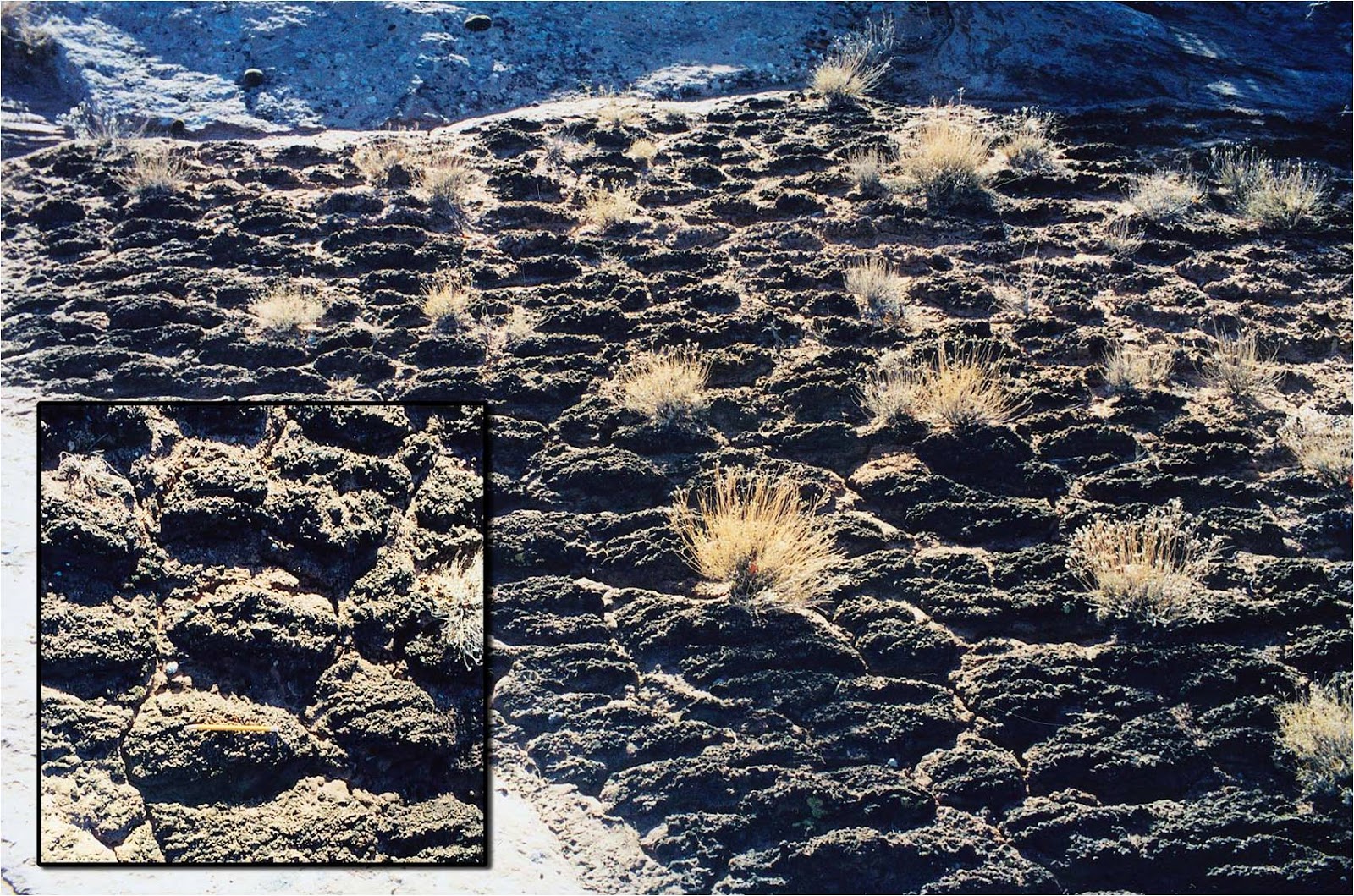
| Fig 1. Subtract out these grasses, and you might have a good analog for the first ecological communities to colonize the land (Beraldi et al. 2013, image: Bowker et al. 2002). |
Ever since about 3.5 (+?) billion years ago Earth has been the planet of the cyanobacteria (also correctly called blue-green bacteria and incorrectly called blue-green algae). We may have invented all kinds of interesting names for different parts of Earth's history (age of the fishes, age of the reptiles, etc.) in our animal-centric way, but in the background of all that there were the cyanobacteria quietly conducting the yin of global ecosystem function, primary production (decomposition being the yang). They "invented" oxygenic photosynthesis. They became engulfed by other organisms and were modified into the chloroplasts of plants and algae....so one could argue that cyanobacteria and modified cyanobacteria still conduct most of Earth's photosynthesis. These organisms drove mass extinctions, rusted the planet, and allowed a radiation of oxygen consuming organisms like humans by creating an oxygen rich atmosphere. They may have induced some glacial periods by locking up carbon dioxide. They were early colonizers of land, perhaps among the first (Beraldi-Campesi 2013; Fig.1). They engage in mutualistic relationships with plants and a variety of fungi. They are dominant phytoplankton in the oceans, and they are found in all terrestrial ecosystems from the hottest to the coldest, wettest to the driest. In short the Earth would be a fundamentally different planet without them.
In addition to being a pillar of the biosphere, they must have some very intriguing capabilities to exist essentially anywhere with light and at least occasional water. A case in point are the desert biocrusts, whose chief architect in the cooler deserts is the cyanobacterium Microcoleus vaginatus. They need light to photosynthesize, so they have to be near the soil surface....but think about what that implies: they must be able to tolerate their environment drying out, and they must be able to handle that sun, especially UV, exposure. This leads to two interesting abilities: desiccation tolerance and the ability to move in response to stimuli. Cyanobacteria inhabit the world's deserts because some of them are masters of desiccation tolerance: drying without dying. They pay a cost in terms of cellular damage when they dry down, but unlike you, me, your houseplants, or your dog, losing almost all of their water does not kill them. When dry, they power down completely, and simply sit there until they are moistened by liquid water and can restart their metabolism.
 |
It gets even more interesting. Microcoleus forms threads of cells called filaments. Many filaments bundle together inside a tube of polysaccharides (what a normal person might call slime) that they goop out into the environment (Fig. 2). The tubes often run from a few mm below the soil surface to the very surface. They can slide up and down these slime tubes! Why might they move up? If water is adequate, but light could be better (for example during a rainstorm), the very surface is the place to be. Because of their susceptibility to UV, they can also retreat down a bit if light intensity increases. They also retract back into the soil as it dries, because they don't "want" to desiccate on the surface only to site there for days, weeks or months degrading in the sun (Garcia-Pichel & Pringault 2000).
Because rain events and solar influx are not exactly scheduled events, one might hypothesize that all of these things ought to be regulated by gene expression triggered and set into motion by the wet-up and dry-down events themselves. Recently a team of researchers at the Lawrence Berkeley National Laboratory made the news when they tracked a wetup and dry down period in a biocrust, continually monitoring what genes turned on and off and therefore which processes where engaged. This gives us a glimpse for the first time of a desert cyanobacterium's prioritized to-do list when activated.
First, check out this video by the Berkeley team of a wet-up event below. You see bubbles of gas forming. This is probably mostly carbon dioxide at first giving way to mostly oxygen later, because respiration is engaged immediately to repair the damage sustained in the last dry-down and photosythesis takes a bit longer to ramp up. You'll see a visible greening as the filaments migrate up their slime tubes to the surface.
Next, check out their other video of a dry-down event. This video begins with a green surface because the filaments are lying there, then you can see the surface become less green because the filaments are retracting into their sheaths. The retracted filaments can now dry-down in peace below the surface without too much risk of major damage by the sun.
The Berkeley team found that there were essentially three clusters of genes that tended to be expressed at the same time. These could be correlated with three time periods: Early wet up, daily cycles, dry-down.
I'm no biochemist, so I'll just summarize a few highlights that I found intriguing, and maybe the authors will chime in in the comment box (ahem...!!). Upon wetting up & "waking" up, the cyanobacterium finds that it left on some genes important in the last dry-down. It shuts these off. Then it turns on the genes to move around nutrients, and start making chlorophyll and ATP....in other words "topping off the tank" to start photosynthesis and respiration. It also turns on genes to fix DNA damage, because that last dry-down did some oxidative damage. While wet the organism enters an alternating cycle of pulsed photosynthesis-linked gene expression triggered by the light environment, some of which shut down at night. Microcoleus is just going about its work week, punching the clock for the daily photosynthesis, and taking its payment in carbon. Then, eventually, the day of reckoning comes....its starting to dry down. we already know its not going to die, but this is a period of time where membranes are damaged and the cells are affected by oxidative damage. Luckily, this guy keeps an emergency box of genes just for such occasions. Microcoleus keeps photosynthesis and respiration running until the bitter end. It also starts expressing genes to defend against the coming reactive oxygen (pumping in Mn as enzyme cofactors!!!). It expresses genes to help maintain osmotic balance. Perhaps the coolest....it turns on genes to transport sugars & therefore energy. This may seem strange seeing as how the organisms is in the process of shutting down, but it could help speed things up when the organism wakes back up. Is this the desert cyanobacterial equivalent of laying out your clothes and shoes for the following day before going to bed?
Literature Cited
Beraldi-Campesi H. 2013. Early life on land and the first terrestrial ecosystems. Ecological Processes 2:1.
Bowker MA, Reed SC, Belnap J, Phillips S. 2002. Temporal variation in community composition, pigmentation, and Fv/Fm of desert cyanobacterial soil crusts. Microbial Ecology 43:13-25.
Garcia-Pichel F, Pringault O. 2001. Cyanobacteria track the water in desert soils. Nature 413: 380-381.
Rajeev L, Nunes da Rocha U, Klitgord N, Luning EG, Fortney J, Axen SD, Shih PM, Bouskill NJ, Bowen BP, Kerfield CA, Garcia-Pichel F, Brodie EL, Northen TR, Mukhopadhyay A. (2013). Dynamic cyanobacterial response to hydration and dehydration in a desert biological soil crust The ISME Journal DOI: 10.1038/ismej.2013.83


